October 4th Phenomenology.
- arturonp05
- Oct 4, 2024
- 2 min read
Updated: Nov 15, 2025
Today was the first day of the Body and Interior Space module and the theme was Phenomenology. Which is a way of seeing the world and looking beyond the mere appearance of things in order to have a deeper understanding of it. The etymology of term is the study of knowledge (logy or logos), drawing upon Ancient Greek; phainomenon "that which appears or is seen.” In the presentation the allegory of Plato’s Cave to suggest that what we judge to be true compromises the authenticity of lives because we are bounded to a superficial understanding of the world. The allegory describes people who have been chained inside a cave their whole life and how the shadow of figures casted on the cave wall become reality to the prisoner when in actuality they are just a shadow cast by the sun.

After I read “Dwelling, Place and Environment: Towards a Phenomenology of Person and World” originally published by David Seamon, and Robert Mugerauer 1985. Chapter 11 ‘A Phenomenological Approach to Architecture and its Teaching in the Design Studio’ connected phenomenology to design. And Chapter 12 ‘The Dwelling Door: Towards a Phenomenology of Transition.’ Described subjectivity as a concept of phenomenology.
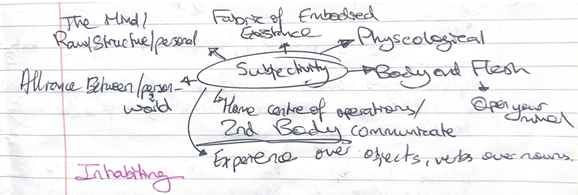
“There is a loss of intimacy, in Martin Heidegger’s words ‘loss of nearness’ between people and their world as well as between person and person”(Seamon & Mugerauer, 2012 p. 184) I found this quote interesting as it shows how people have lost the ability to connect with space and in turn architecture has now become a service rather than a form of art. “Subjectivity is not a dream that passes over reality nor is it a surveying of thought or a mechanical process” (Seamon & Mugerauer, 2012 p. 201) This quote is what really got me interested in phenomenology it shows how subjectivity must be thought of with an open mind, thinking about our relationship with the world to create an alliance with it. The book continues by giving an example from Maurice Marleau-Ponty’s the ‘Structure of Behaviour’ where he uses the example of a football player’s body unconsciously moving through articulate pathways when in the field. They understand each other and become a new body together because there is a sense of ‘familiarity.’ Familiarization is “Performed as if by magic by the active body. It is enacted at the most primitive level without the assistance of conscious thought” (Seamon & Mugerauer, 2012 p. 202-203) Showing the ability to unconsciously connect with space is the most primitive process of the unconscious mind. This idea reminded me of Martin Heidegger who was discussed in the class presentation, as he explored his phenomenological ideas through primal notions.



Books I used to further research Phenomenology
I believe that I should be conscious and aware of my designs as well as the impact they will have on the environment and on the quality of human life. After today’s research how I perceive and understand the world will no longer be the same.
References:
Seamon, D., & Mugerauer, R. (Eds.). (1985). Dwelling, place and environment: Towards a phenomenology of person and world. Springer Netherlands.


Comments