November 22nd Identity.
- arturonp05
- Nov 22, 2024
- 2 min read
Updated: Nov 15, 2025
Today we explored the theme of identity, which is a social and self-perception, built on the synthesis of individual and professional aspects. (Kunrath, Cash, Li-Ying, 2016) To further understand this we looked at terminology such as gender, sex and sexuality and I made some diagrams in order to understand how these ideas, compare and connect to one another.




Diagrams made in class to fully understand how themes in identity connect to one another.
This leads onto intersectionality, which explains how our identities cannot be separated because every part of us makes up our experience for instance, we cannot group ‘women’ together since the experience of a black woman will be vastly different to one of a white woman, because of their race both will navigate the world very differently, and if we take this even further the experience of a ‘gay white woman’ will be different to one of a ‘straight white woman.’

Gender fluidity

Le Cobusier's Study of Human Proportion
An example of Identity in design is Gerrit Rietveld’s ‘Schröder house’ designed in 1924 the female client required a space that allowed her to keep an eye on her children while still having the opportunity to isolate from them. The result was a space with moving panels that unify the interior spaces and make a very flexible environment.




Gerrit Rietveld’s ‘Schröder house’
Architecture is not just made by designing but how you use the space, how you move around, how we design allows certain interactions to occur. The kitchen for example, was where women traditionally lived and was largely forgotten about. ‘The Frankfurt Kitchen’ designed by Margaret Schütte-Lihotzky in 1926 aimed to solve this issue with ergonomics in mind; it would become a space where women could move from around with little to no steps. However, it would later be criticised by second wave feminists for ‘Isolating’ women in the kitchen and making them invisible. (Guardian staff reporter, 2024)


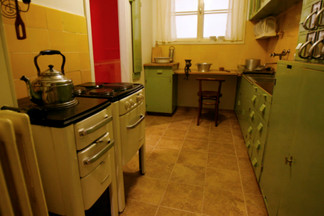


Margaret Schütte-Lihotzky's Frankfurt Kitchen.
Charlotte Perriand’s ‘Kitchen for an apartment in Le Corbusier’s Unité d’Habitation’ designed in 1950 keeps the same design as the Frankfurt Kitchen but changes one thing a wall is replaced with a kitchen bar. Opening the space to the rest of the home. Perriand had thought about her own experience in the kitchen and ensured her new design would liberate women.


Charlotte Perriand’s ‘Kitchen for an apartment in Le Corbusier’s Unité d’Habitation’
I find it so interesting how a space changes throughout history in order to adapt and comply with the changing desires and requirements of modern living. As an architect student I believe I should be conscious and aware of my designs and the impact they will have on the environment and on the quality of human life.
References:
K. Kunrath, P. Cash and J. Li-Ying (2016). Designer’s Idenitty: Personal Attribute and Design Skills International Design Conference – Design 2016
Guardian staff reporter. (2024, November 12). “That damned kitchen!” How the inventor of the fitted kitchen came to see it as a curse. The Guardian; The Guardian. https://www.theguardian.com/artanddesign/2024/nov/12/damned-kitchen-inventor-fitted-frankfurt-margarete-schutte-liho


Comments