Brutalism is not the enemy we think it is…
- arturonp05
- Mar 9, 2024
- 2 min read
Updated: Nov 16, 2025
Most people will tell you without a doubt in their mind that brutalism is a horrendous eye sore and that it should not even exist, without really knowing anything about its ideologies and ideas.
Brutalism is a style of architecture partly inspired by democratic-socialist visions and was heavily propelled by the Avant-garde movement of the mid20th century. Emerging after the Second World War, when there was a heavy demand for large-scale affordable housing and urban reconstruction its ideas were embedded in functionality and simplicity. (The Art Story, n.d.) It can be described as a type of minimalistic construction with an emphasis on raw structure, textures and materials for instance, consider a monochromatic palette of bare concrete, steel, brick and glass. (RIBA, 2019) Today you will see that the majority of our urban landscapes are composed of brutalist buildings, which have a stark contrast to traditional architecture. Personally, I find it quite heart-breaking to see the beautifully ornate buildings that have stood for decades be repurposed for stern, bare, uninviting, formidable and dystopian structures with no soul. All for low-cost housing and cheap minimalistic buildings.

Litchfield Towers, Dettere and Richtey, 1963
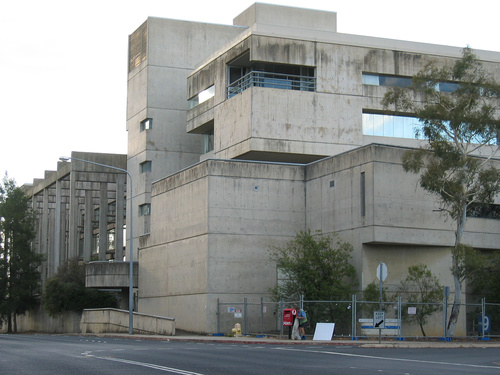
Cameron Offices, John Andrews, 1972
On the other hand, brutalism can sometimes be positive and advocate for a more utopian future despite its soulless appearance. The Alexandria Road Estate was built in the 1970s by architect Neave Brown, after the Camden Council realised that high-rise tower blocks were a social nightmare. Alexandria Road was built low, to fill the site and designed geometrically to define open space, returning the traditional values of homes, giving each dwelling a front door to the street and its own private space with a view to the sky. (Municipal Dreams, 2013) In the words of the architect, “Instead of violating the environment with towers and slab blocks surrounded by undefined space, we wanted to do housing that acknowledges our traditions and made a piece of a city.” (Neave Brown, 1995) Brown built the estate with the street at its core, where neighbours can socialise and children can play. While some residents may compare it to the likes of Alcatraz (Municipal Dreams, 2013) there is no doubt that the estate has propelled the idea of social housing regardless of all the criticism it has received for its brutalist style.

Street on Alexandria Road Estate

View of the Back of homes on The Alexandria Road Estate
Bibliography:
With this in mind what do you guys now think about brutalism? Do you still believe it deserves all the hate it receives?
RIBA. (2019). Brutalism. Architecture.com. https://www.architecture.com/explore-architecture/brutalism
The Art Story. (n.d.). Brutalist Architecture Movement Overview. The Art Story. https://www.theartstory.org/movement/brutalism/
Tate. (2017). Avant-garde – Art Term | Tate. Tate. https://www.tate.org.uk/art/art-terms/a/avant-garde
Municipal Dreams. (2013, June 18). The Alexandra Road Estate, Camden: “a magical moment for English housing.” Municipal Dreams; Municipal Dreams. https://municipaldreams.wordpress.com/2013/06/18/the-alexandra-road-estate-camden-a-magical-moment-for-english-housing/
Image Credits:
10 Iconic Brutalist Buildings You Should Know - Monograph. (n.d.). Monograph.com. https://monograph.com/blog/brutalist-buildings
Alexandra Road Estate. (n.d.). Architectuul. https://architectuul.com/architecture/alexandra-road-estate


Comments